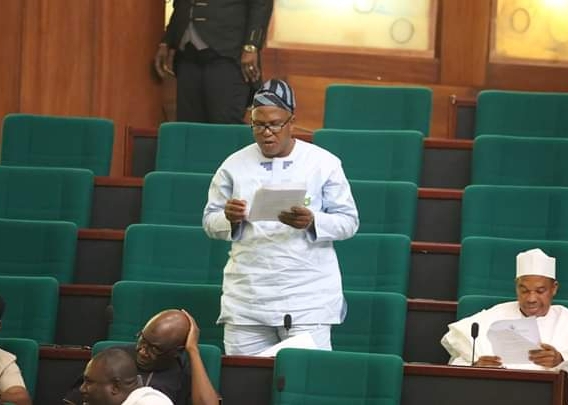
Ondo Rep, Akinfolarin sponsors National Cocoa Board Bill
The member representing Ileoluji-Okeigbo/Odigbo Federal constituency at the house of representatives and Chairman, house committee on Federal Road safety Commission, Honourable Mayowa Akinfolarin has sponsored a bill for the creation of a Federal Board to supervise and manage the Cocoa value chain in Nigeria for better gains for Farmers and the government.
The bill which was sponsored to provide for an effective legal and institutional framework for the administration and management of the entire value chain in the production of Cocoa in Nigeria and for the establishment of the National Cocoa Board was presented on the floor of the house on Tuesday, 7th of July 2020 by the Ranking honourable member.
Akinfolarin, while presenting the Bill on the floor of the house noted that:
“Cocoa farming is a very vital part of the agro – allied sector because it provides food for the entire population, raw material for industry and revenue from export. Hence, it also serves as a source for foreign exchange in Nigeria.”
He further said:
“Cocoa was a major agricultural export crop and a top foreign exchange earner in the 1950s and 1960s. Prior to the discovery of crude oil in commercial quantities in the 1970s, Nigeria was the world’s second largest producer of cocoa.”
“Nigeria is currently the world’s fourth largest producer of the crop, after Ivory Coast, Indonesia and Ghana. It is also said to be the third largest exporter, after Ivory Coast and Ghana. As mentioned above, cocoa was a major foreign exchange earner for Nigeria in the 1950s and 1960s and in 1970 the country was the second largest producer in the world. But, following investments in the oil sector in the 1970s and 1980s, the country’s share of world output declined.”
He further posited that:
“Historically Nigeria’s cocoa production was marketed through a monopsony by Marketing Boards created by the government. In the 1980s the World Bank and the International Monetary Fund advised Nigeria and other countries to liberalize the sector because the Marketing Boards were alleged to be ineffective and in 1986, Nigeria dissolved the Marketing Boards and liberalized cocoa marketing and trade.”
According to Akinfolarin:
“A cursory look at the cocoa industry reveals that despite Nigerian cocoa farmers getting one of the highest prices for cocoa in the world, Nigeria has not been able to maintain its erstwhile dominance in the world cocoa market on account of numerous challenges. With regards to domestic production, Nigeria is plagued with stagnant crop size- old cocoa trees, old and ageing farmers, not many new plantations, lower yields per hectare, as well as lack of awareness of good practices by farmers and non-availability of good quality inputs (fertilizer/ chemical).
He further noted that:
Also worthy of note is inconsistent quality of beans, high interest rate and operating costs occasioned by relative lack of investment in cocoa sustainability initiatives by the chocolate industry.”
The lawmaker emphasized the need for this bill to be passed to help solve all these problems encountered by cocoa farmers in the country.
“The essence of a cocoa Marketing Board is not just to regulate the sector, but also for the provision of welfare support to cocoa farmers, as they are an important part of the sector in Nigeria. As in other thriving countries, farmers are being supported by the existing institutional frameworks.”
“The re-introduction of the Cocoa Marketing Board in Nigeria which is aimed at strengthening the sector, will further aid in the dynamic development of the economy, hence the need for this Bill.” He concluded.
It is worthy of note that Akinfolarin, who is also the Ondo Reps caucus leader has a number of other bills and motions to his credit in the green chamber.